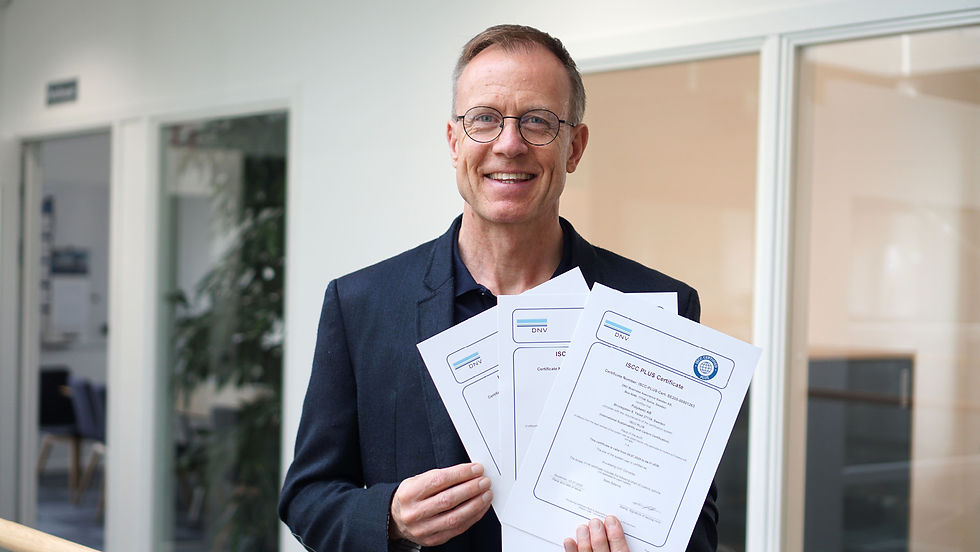
Circular collaboration that reduces plastic waste
Updated: Mar 3
Since 2015, Rondo Plast (Polykemi Group) has regularly purchased production scrap from Modulpac. The collaboration contributes to resource-efficient plastic use, reduces unnecessary incineration of plastic, and demonstrates that circularity is fully achievable.

Growing demand
Rondo Plast purchases production scrap and by-products of PP and PE from Modulpac’s manufacturing of caps, jars, and lids. Both PP and PE are major polymers in Rondo Plast’s production and are in high demand among customers.
“We have seen increasing demand for recycled plastic materials over the past ten years. The demand primarily concerns PP, but also engineering plastics such as PC, ABS, PA6 and PA66,” says Patrik Lindqvist, Category Manager Recycled Materials at Rondo Plast.
Knowledge exchange enhances material quality
From the start, the collaboration between Modulpac and Rondo Plast has been characterized by close contact, open dialogue, and mutual knowledge exchange.
“Everyone wants to minimize waste, no one is uninterested in optimizing material use. What we do is familiarize ourselves with the supplier’s process, explain our own, and then support our suppliers – in this case Modulpac – in managing their scrap so that the leftover material that is generated can be sold to us instead of being incinerated, thereby creating economic value,” says Patrik Lindqvist.
Through transparent exchanges, Modulpac has established efficient scrap management, and Rondo Plast has gained a supplier capable of delivering plastic that is free from contamination and sorted by polymer.
“Modulpac’s willingness to collaborate is highly valued by us. Their efficient handling is essential for our ability to upgrade and refine by-products into high-quality recycled plastic.”
Clear benefits of scrap management
The collaboration is a strong example of how by-products can be returned to the value chain and contribute to increased circularity.
“For circularity to become a reality, it is important to recognize that plastic can be recycled, and that recycled plastic can meet very high-quality standards. Unfortunately, recycled sources still suffer from an undeserved negative reputation,” says Patrik Lindqvist.
If more companies recognized the opportunity to sell their scrap instead of sending it to incineration, significant benefits could be achieved.
“The obvious effect of more efficient scrap management would be a reduction in the amount of material sent to incineration and making plastic an even more circular material – something it has great potential to be.”